
OEM vs. Aftermarket: Is the Price Difference Actually Worth It?
If you are facing a vehicle repair, you will inevitably reach a fork in the road. Your mechanic, or your online shopping cart, will ask you a critical question: “Do you want OEM or aftermarket parts?”
One choice matches the sticker price of the vehicle when it was new. The other often looks like a bargain. But this decision isn’t just about the immediate impact on your wallet. The choice between Original Equipment Manufacturer (OEM) parts and aftermarket alternatives affects your car’s performance, its longevity, your safety, and even its resale value.
So, is the higher cost of OEM parts actually worth it? The answer isn’t a simple yes or no it depends entirely on what part you are replacing. This guide will break down the crucial differences, advantages, and drawbacks of both options so you can make an informed, confident decision.
What is the Difference?
Before we dive into the economics, let’s define the terms.
1. OEM (Original Equipment Manufacturer) Parts
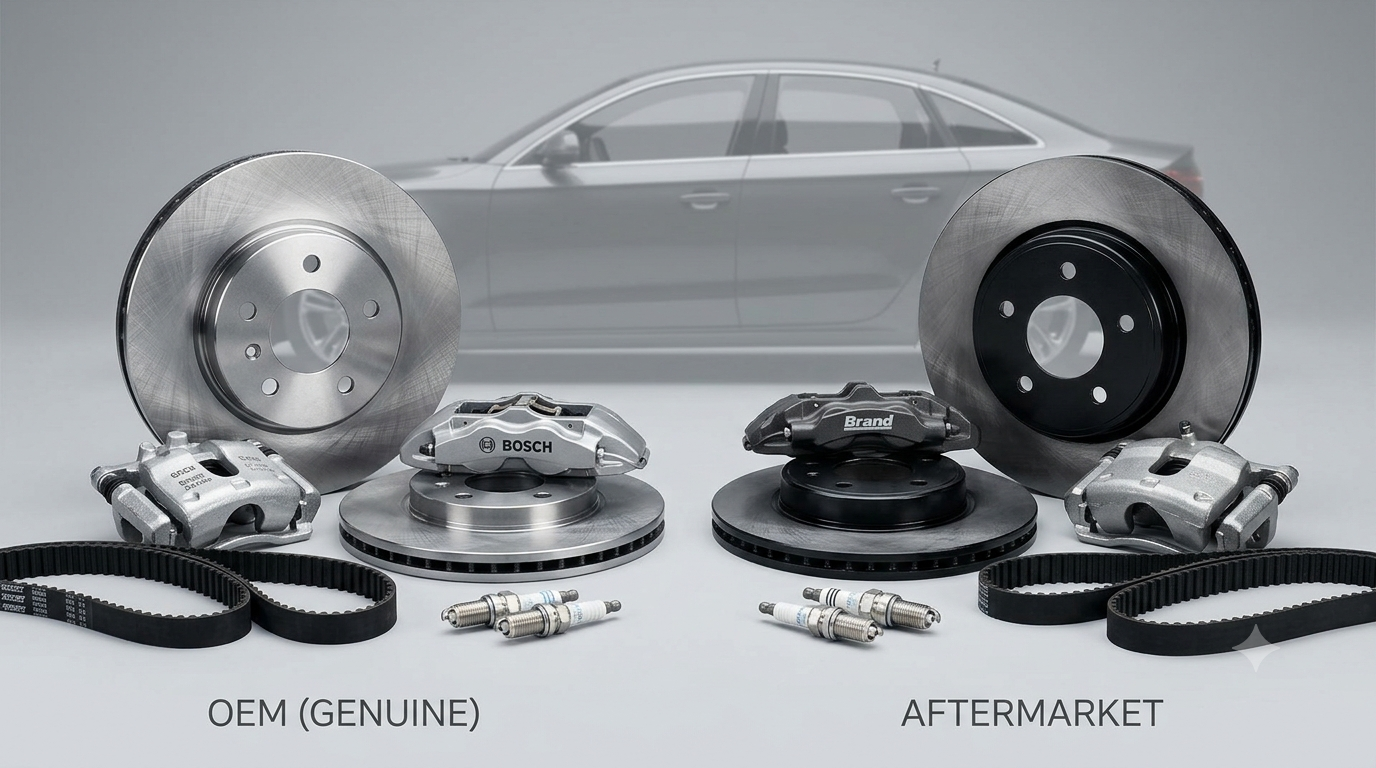
OEM parts are produced by the company that built your vehicle (or by a subcontractor commissioned specifically by them to build the part to exact specifications). They are identical to the parts your car came with when it rolled off the assembly line.
- Fitment: Perfect. It is designed precisely for your vehicle.
- Purchasing: Typically sold only through authorized dealerships.
2. Aftermarket Parts
Aftermarket parts are produced by third-party companies. These companies did not make the original parts for your car. Their goal is often to create a component that functions similarly to the original, usually at a lower cost.
- Fitment: Can vary widely. It may be “universal fit” (designed to work on multiple vehicles) rather than vehicle-specific.
- Purchasing: Widely available at any independent auto parts store or online retailer.
OEM Parts: The Case for Quality and Assurance
There is a reason professional repair shops and safety experts often advocate for OEM, despite the premium price tag. You are paying for certainty.
Advantages of OEM Parts
- 1. Guaranteed Performance and Fit: This is the biggest selling point. With OEM, you don’t need to cross your fingers and hope the bolt holes line up. The material strength, dimensions, and operational tolerances are engineered precisely to keep your vehicle running exactly as designed.
- 2. Enhanced Safety (Crucial): OEM parts undergo rigorous testing. For critical components like brake systems, airbags, or structural body panels, this testing ensures the vehicle’s safety systems including advanced sensors function perfectly during a collision.
- 3. Peace of Mind Warranty: Almost all OEM parts come with a nationwide warranty (usually 1 year or 12,000 miles) that is honored at any authorized dealership.
- 4. Simplifies The Decision: When buying OEM, there is only one part number. You don’t need to spend hours comparing five different brands and reading conflicting reviews.
Disadvantages of OEM Parts
- 1. significantly Higher Cost: OEM parts can cost 60% more (or higher) than their aftermarket equivalent.
- 2. Limited Availability: You often have to go to a dealer to get them, or wait for them to be ordered from a central warehouse.
Aftermarket Parts: The Case for Savings and Choice
Aftermarket parts own a huge portion of the market because they solve the primary concern of many vehicle owners: cost. But the landscape is vast and inconsistent.
Advantages of Aftermarket Parts
- 1. Significantly Lower Cost: This is the main attraction. For older vehicles or non-critical components, the savings can be massive.
- 2. Greater Availability: You can walk into almost any local auto parts store and leave with the aftermarket part you need that day.
- 3. Potential for Better Quality: This sounds counterintuitive, but sometimes third-party companies will reverse-engineer an OEM part that has a known failure point and redesign it using better materials to fix that specific weakness.
Disadvantages of Aftermarket Parts
- 1. Inconsistent Quality: This is the primary risk. The market is flooded with low-grade, poorly engineered, and even counterfeit parts. The material quality might be inferior, causing them to wear out faster.
- 2. Fitment Issues: Universal parts often require modifications, extra brackets, or simply never fit “quite right,” which can cause noise, vibrations, or leaks down the line.
- 3. Limited or Non-Existent Warranty: Many aftermarket parts come with a “tail-light warranty” (it expires when the seller can no longer see your tail-lights). Even good warranties may require you to ship the part back at your own expense.
So, Is the Price Difference Worth It?
The price difference for OEM is usually worth it when the part is critical to the vehicle’s core function, safety, or resale value. Aftermarket is a good choice for parts that are simple to replace or don’t affect your car’s fundamental engineering.
Where You Should NOT Skimp (Use OEM)
Do not use aftermarket parts for these critical systems:
- Safety Components: Brakes, rotors, pads, airbags, and collision sensors must be OEM.
- Engine and Transmission Internal Parts: Timing belts, internal gears, and critical engine sensors are engineered to specific tolerances. A failure here can destroy your entire engine.
- Complex Electrical Systems: Modern ECUs, body control modules, and wiring harnesses rely on precise resistance and voltage compatibility. Aftermarket electronics often cause nightmare diagnostic issues.
- Vehicles Under Warranty: Using certain aftermarket parts can void your existing vehicle manufacturer’s warranty.
Where You CAN Save Money (Use High-Quality Aftermarket)
You can confidently use reputable aftermarket brands (like Bosch, Denso, Moog, or Akebono) for:
- Wear-and-Tear Maintenance: Air filters, cabin filters, windshield wiper blades, and spark plugs (provided they meet OE specifications).
- Exterior Body Panels and Glass: For non-structural bodywork (like a fender mirror or door handle) on an older car, aftermarket is usually fine.
- Simple Suspension Components: Sway bar links or control arms on a vehicle that isn’t a performance machine.
- Fluid Replacements: Oil, coolant, and brake fluid, provided they meet the specific viscosity and safety certifications required by your owner’s manual.
Final Verdict
The price premium for OEM is worth it for critical function, safety, and modern diagnostic systems. It is an investment in your safety and your car’s longevity.
The lower cost of aftermarket is worth it for older, high-mileage vehicles, simple cosmetic repairs, and routine maintenance items where a reputable third-party brand is well-regarded by the mechanic community.
If you are ever in doubt, ask your mechanic why they are recommending one over the other. A trustworthy shop will explain the specific risks or benefits relative to your particular vehicle.