

How Do Hybrid Battery Replacements Differ from Traditional 12V Batteries?
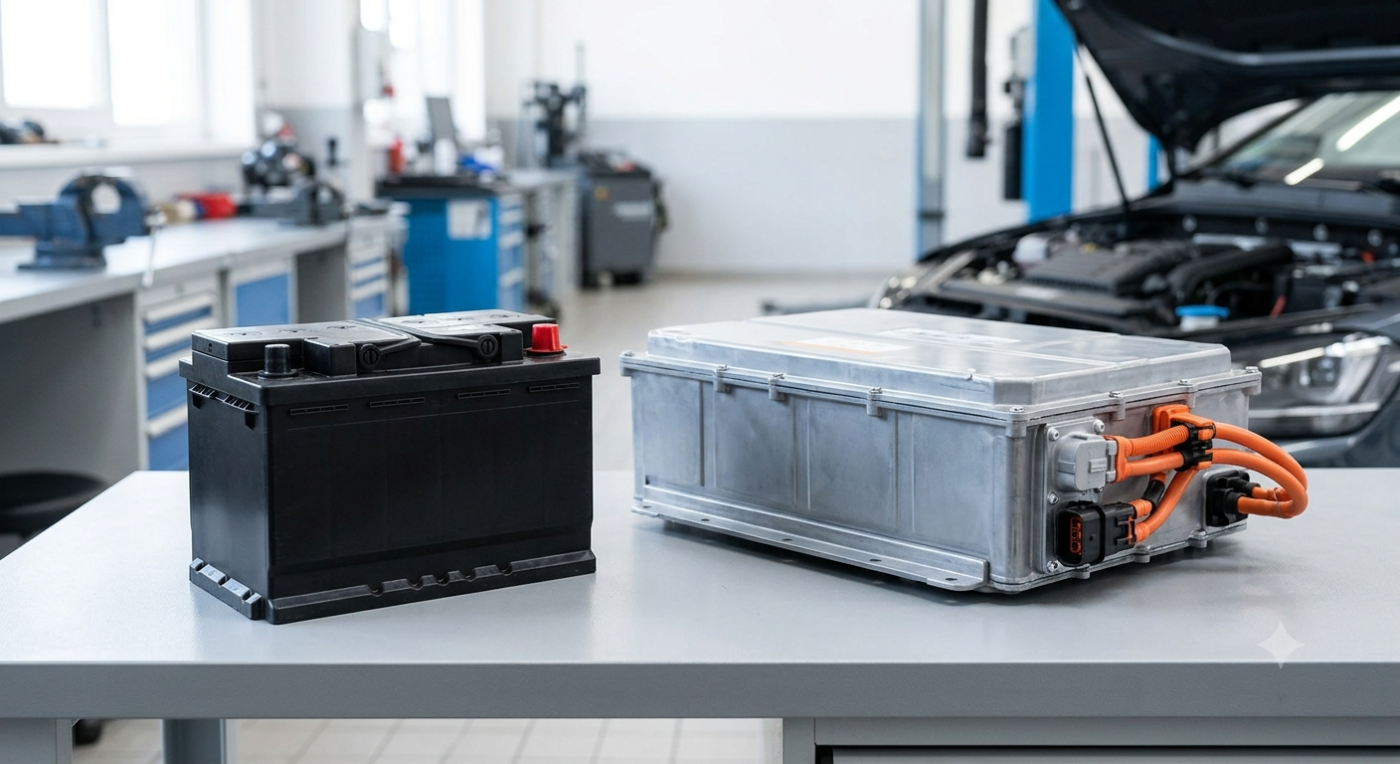
If you are the proud new owner of a hybrid vehicle, or if your trusted older hybrid is starting to show its age, you might be asking yourself a critical question: “How is the hybrid battery different from the regular car battery I’m used to?”
This is one of the most common points of confusion for hybrid drivers. We all know the drill with traditional 12V batteries you go to an auto parts store, buy a black box for $150, and swap it out in twenty minutes.
A hybrid battery replacement is a completely different animal. It is different in its function, its size, its chemistry, the cost of the part, and the labor required to replace it.
In this comprehensive guide, we will break down the crucial distinctions so you can make informed decisions about your vehicle’s maintenance.
1. The Core Job: What Does Each Battery Do?
The single biggest difference between these two batteries is what they are designed to power.
Traditional 12V Starter Battery
Think of the 12V battery as the vehicle’s electrical supervisor. Its main jobs are:
- Cranking: Providing the initial burst of power needed by the starter motor to turn over the internal combustion engine (ICE).
- Accessories: Powering low-voltage systems when the engine is off (e.g., headlights, radio, interior lights, power windows, central locking).
Hybrid (Traction) Battery Pack
The hybrid battery is the vehicle’s primary muscle. It doesn’t just supervise; it propels. Its jobs include:
- Propulsion: Powering the electric motor(s) that drive the wheels. In full hybrids (HEVs) and plug-in hybrids (PHEVs), this is the main energy source for electric driving.
- Regenerative Braking: Storing the kinetic energy captured during braking to be reused for acceleration, significantly improving fuel efficiency.
Crucial Insight: Your hybrid vehicle has BOTH. It needs the 12V battery to start its computer systems and close a high-voltage relay. Once that relay closes, the big hybrid battery takes over the heavy lifting of driving. If your 12V battery dies, your hybrid will not start, even if the hybrid battery is full.
2. Voltage, Size, and Physical Scale
The physical differences are impossible to miss.
| Feature | Traditional 12V Battery | Hybrid Traction Battery |
| Voltage | ~12.6 Volts | ~200V to 600V+ |
| Size | Compact (approx. 9″x7″x8″) | Massive (often filling the space under the rear seat or trunk floor) |
| Weight | ~40 lbs | ~100 lbs to 400 lbs+ |
| Form | A single lead-acid box | A complex pack of hundreds of interconnected cells/modules |
A 12V battery can be lifted with one hand. A hybrid battery pack requires a hoist or multiple people to manage.
3. Difference in Battery Chemistry
They don’t just work differently; they are made of completely different materials.
- 12V Battery: Almost always uses Lead-Acid chemistry. It’s an old, reliable, and cheap technology that is excellent at delivering a quick, high burst of current to start an engine, but it is very heavy relative to the energy it stores.
- Hybrid Battery: Designed for energy density (storing a lot of power in a smaller space) and high cycle life (repeatedly charging and discharging). They typically use Nickel-Metal Hydride (NiMH) (older full hybrids like many Toyotas) or Lithium-Ion (Li-ion) (most modern plug-in hybrids and new hybrids). Li-ion is the superior technology, offering lighter weight and higher energy density.
4. Lifespan and Failure Signs
How long they last and how you know they are dying is vastly different.
12V Battery Lifespan: 3 to 5 Years
Failure Signs:
- Slow or sluggish engine cranking.
- Clicking sound when you turn the key.
- Dimming headlights when using electrical accessories.
- “Battery” dashboard warning light.
Hybrid Battery Lifespan: 10 to 15+ Years (or 100k–200k+ miles)
Failure Signs:
- Significantly reduced fuel economy (mpg).
- The gas engine runs constantly, even at low speeds or when stopped.
- Rapid, erratic fluctuations on the battery state-of-charge display.
- Warning lights: “Check Hybrid System,” “Service Hybrid Battery,” or sometimes the Triangle of Doom (on older Toyotas).
5. Cost of Replacement: Part and Labor
This is where drivers face the biggest reality check.
Traditional 12V Battery
- Part Cost: $100–$250.
- Labor: 0–$50 (many stores install for free).
- Total Cost: $100–$300.
Hybrid Battery Pack
- Part Cost: $1,500–$8,000+, depending on model, capacity (HEV vs. PHEV), and chemistry (NiMH vs. Li-ion).
- Labor: $500–$1,500+. The labor is specialized, requires certified high-voltage technicians, involves high-risk safety protocols, and often requires removing seats or significant trunk disassembly.
- Total Cost: $2,000–$9,000+.
6. DIY vs. Professional Installation: A Matter of Life and Death
Can you replace a 12V battery yourself?Yes. It is a routine DIY task. While you should be careful to avoid sparks, the 12V voltage is not strong enough to deliver a lethal shock.
Can you replace a hybrid battery pack yourself?NO. Unless you are a certified high-voltage automotive technician, absolutely not.
Hybrid battery packs operate at lethal voltages (up to 600 volts). A single mistake while disconnecting the high-voltage (orange) cables can result in severe, instantaneous electrocution. These systems require specialized insulated tools, personal protective equipment (PPE) like high-voltage gloves, and exact de-energizing sequences.
This is a maintenance item that must be left to professionals.
Summary
| Contrast | Traditional 12V Battery | Hybrid Traction Battery |
| Main Job | Powers 12V computers, powers starter | Powers electric motors, propels vehicle |
| Voltage | Low Voltage (~12V) | High Voltage (~200–600V+) |
| Replacement Cost | Low (~$200) | Very High (~$2,000–$9,000) |
| Lifespan | Short (3–5 years) | Long (10–15 years) |
| DIY Safe? | Yes | NO (Lethal Hazard) |
Final Thoughts for Hybrid Owners
A hybrid battery replacement is not a simple fix; it is a major financial decision for your vehicle’s future. The good news is that they are exceptionally reliable and often outlast the owner’s possession of the car. However, when the time comes, knowing that it differs significantly from your routine 12V swap will help you budget, plan, and choose the right certified repair professional.