

Why Are Catalytic Converter Thefts Still Happening, and What Anti-Theft Shields Actually Work? (2026 Guide)
It’s a sound that strikes fear into the heart of any car owner: you start your engine, and instead of a smooth purr, you’re met with a deafening, monstrous roar. Your heart sinks. You slide under the car, and your fears are confirmed. Someone has stolen your catalytic converter.
In early 2026, many drivers hoped this crime wave might be receding, but recent reports confirm that catalytic converter theft has experienced a significant rebound, reaching levels not seen since the peak of the early 2020s.
Why is this problem so persistent despite increased awareness and new state laws? The answer is a mix of high-stakes chemistry, global economics, and a highly efficient, underground recycling ring. Here, we delve into the reasons behind the 2026 surge and analyze which catalytic converter anti-theft shields actually provide real protection.
The Anatomy of the Crime: Why Thieves Want Your Converter
Before we get to the “how,” we have to understand the “why.” A catalytic converter is a crucial part of your exhaust system. Its job is to neutralize dangerous pollutants (like carbon monoxide and nitrogen oxides) before they leave your tailpipe.
However, the converter needs help to create these chemical reactions. That help comes from incredibly rare, incredibly valuable metals, commonly known as Platinum Group Metals (PGMs).
Thieves aren’t after the part itself; they are after the minuscule amounts of metal inside.
The Metal Market Factors (2026 Data)
The single biggest driver of catalytic converter theft is the spot price of these precious metals. When the global market price for PGMs rises, theft surges. When they fall, theft decreases. As of early 2026, we are in another massive “boom” cycle.
- Rhodium (Rh): This is the rarest and most expensive metal in the converter. Rhodium primarily tackles nitrogen oxide (NOx) emissions. After a brief drop, Rhodium prices have exploded again in 2026, reaching over $10,100 per ounce. Its limited supply (mostly from South Africa and Russia) combined with stricter automotive emissions standards globally means its demand and thus its price remains extremely high.
- Palladium (Pd): Used mostly in gasoline vehicles to oxidize pollutants, Palladium has also seen volatile price spikes. In 2026, Palladium has hovered around $1,860 per ounce, driven by industrial demand and geopolitical supply concerns.
- Platinum (Pt): While traditionally cheaper than Palladium, Platinum is crucial for diesel vehicles and is increasingly used as a substitute in gasoline converters. In 2026, its price is strong at around $2,340 per ounce.
Thieves can cut a converter off a car in under 60 seconds with a simple, battery-powered reciprocating saw. They then sell these stolen parts to shady scrap dealers for anywhere from $150 to $1,500 per unit (with high-value hybrid converters on the upper end), depending on the PGM content. The scrap dealer then gets the metals refined and sells them back into the global supply chain, often leaving little to no digital footprint.
Why Hasn’t Legislation Solved the Problem?
It’s not for lack of trying. dozens of states have passed new laws targeting this specific crime. These laws generally focus on a few key areas:
- Restricting Scrap Metal Sales: Many states now require scrap yards to verify a seller’s identity, keep detailed records of transactions, and pay via check rather than cash.
- Creating Specific Offenses: Some jurisdictions have made the possession of a cut-off catalytic converter without proof of ownership a criminal offense.
- Stricter Penalties: Sentences for convictions related to catalytic converter theft have increased in many regions.
However, these laws face significant hurdles:
- Arbitrage and Cross-Border Trafficking: A thief can steal converters in a state with strict regulations and drive across state lines to a state with weaker laws to sell them. Without federal legislation closing these regulatory gaps, local enforcement remains limited.
- Sophisticated Criminal Rings: Organized crime groups have adapted, creating complex logistical chains to gather stolen units from various regions and transport them to high-volume processors or refiners.
- Refining Difficulty: The ultimate buyers the refiners are often located overseas or in regions where tracing original ownership is virtually impossible. Once the converter is melted down, the metal itself cannot be linked back to a specific vehicle.
Are Some Cars At Higher Risk Than Others?
Yes. Thieves have “wish lists” of vehicles that offer the biggest payoff for the least effort.
High-Risk Vehicle Types:
- Hybrid Vehicles: Because their combustion engines cycle on and off, hybrids are exceptionally efficient at capturing nitrogen oxides, making them the “golden standard” for PGM content. Specifically, the Toyota Prius (especially earlier models) is the most targeted vehicle on the road. A Prius converter can contain several times more Rhodium than a standard gasoline car, making it worth $800–$1,500 on the scrap market.
- Trucks and SUVs: These vehicles have larger engines and, therefore, larger converters with more PGMs. Just as importantly, they have high ground clearance, allowing a thief to slide under without needing a jack, often speeding up the theft significantly. Targeted models often include the Ford F-150, Chevrolet Silverado, and Toyota Tundra.
What Anti-Theft Shields Actually Work? (Tested Deterrents)
Since the police or legislation are unlikely to prevent your specific theft, proactive, physical deterrents are your best line of defense. The goal isn’t to make the converter uncuttable, but to make the job take too much time, noise, and effort, forcing the thief to move on to an easier target.
We’ve reviewed the leading products on the market to determine their real-world effectiveness.
1. The Full Belly Pan Shield (e.g., Cat Security, MillerCAT)
These are large, robust sheets of aluminum or stainless steel that bolt directly onto your vehicle’s frame, essentially creating an armor plate under your entire exhaust system.
- Why it Works: It completely hides the converter and blocks all access to the exhaust pipe. To steal it, a thief must first cut through or unbolt the entire shield a complex and loud operation.
- Effectiveness: Very High. These are perhaps the most effective deterrent for targeted models like the Prius.
- Installation: Involves significant labor and tools. Professional installation is highly recommended to ensure proper fitment and heat management.
- Drawback: Can slightly reduce ground clearance.
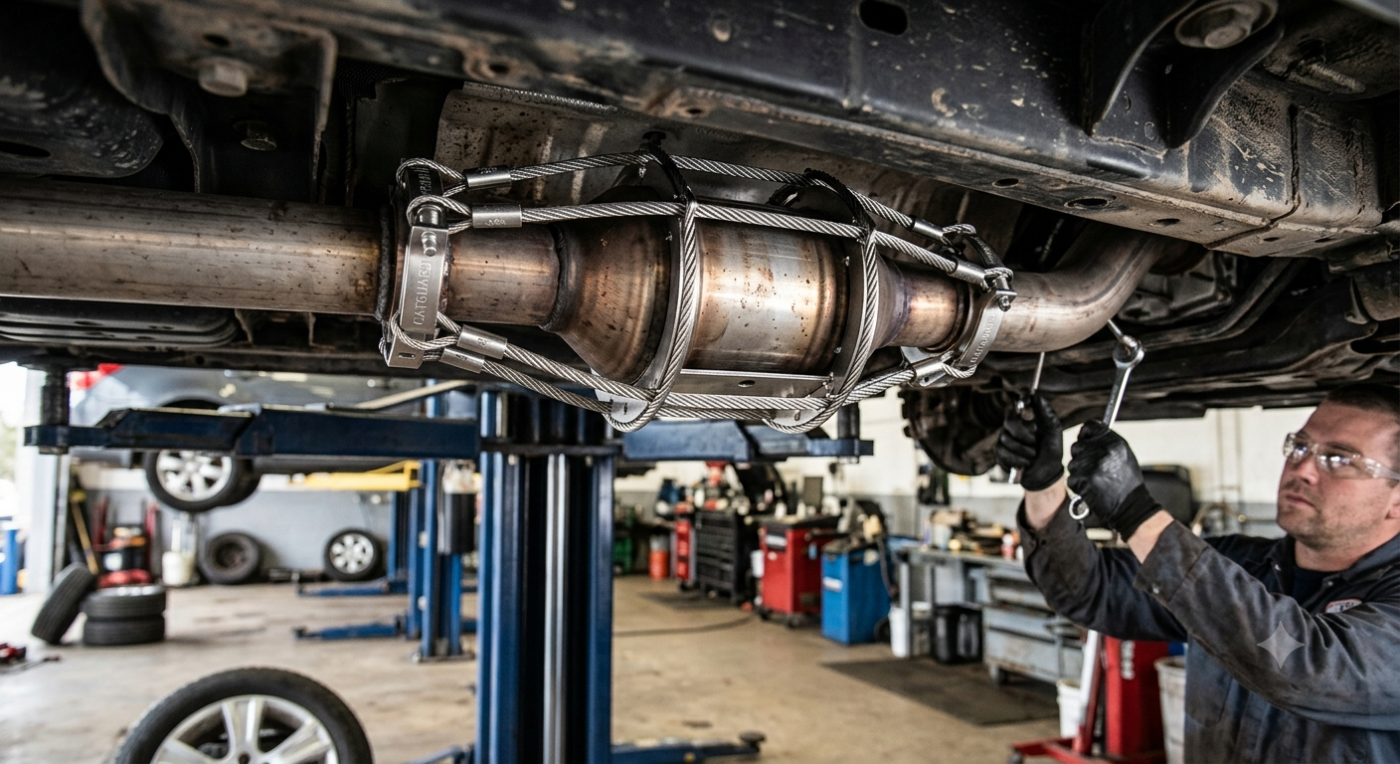
2. The Cage/Lock Deterrent (e.g., CatClamp)
This design uses braided stainless steel cables that weave around the catalytic converter and clamp onto the exhaust pipe or attach to the vehicle’s chassis, often multiple times.
- Why it Works: These cables are incredibly difficult to cut with a reciprocating saw (the typical thief’s tool). As the saw blade hits the braided cable, the individual strands tend to fray or “snag,” rendering the saw ineffective and creating massive frustration for the thief. It creates too much work for a thief in a hurry.
- Effectiveness: High. While technically cuttable with the right tools (like a diamond-grit blade), it’s highly resistant to standard Sawzall blades.
- Installation: Intermediate. Model-specific and universal kits are available, requiring standard tools but significantly more effort than simple clamps. Open design allows normal heat dissipation.
3. The Strap Shield (e.g., CatStrap, CatEye Alarm)
This is a physical barrier strap (often bright orange as a visual deterrent) that bonds to the exhaust pipe and has hardened steel layers beneath. It can be paired with an electronic motion alarm.
- Why it Works: The primary strategy here is layered defense. The bright orange strap is the first visual warning. If that’s ignored, the layered hardened steel strips inside repel saw blades. The heat-activated adhesive makes it near-impossible to remove without cutting. The best version pairs this strap with a sonic motion sensor (CatEye), activating a 130 dB ear-piercing siren upon human movement. The confinement of being under a car with a 130 dB alarm forces most thieves to flee before damage is complete.
- Effectiveness: High (especially with the alarm bundle). The alarm adds a critical layer of psychological defense.
- Installation: Easier to intermediate. Clamps and adhesive strips make installation simpler than a full pan shield.
Summary: A Multi-Layered Approach is Best
Catalytic converter theft in 2026 is an economic reality. Until Rhodium prices fall significantly or federal legislation closes the regulatory gaps, thieves will continue their high-speed, high-payoff trade.
Your best protection strategy is a multi-layered approach:
- Visual Deterrent: Bright orange straps, warning stickers, or simply etched or painted converters make your car look protected.
- Sound Deterrent: A specialized motion alarm bundled with a physical barrier (like the CatEy/Strap combo) is extremely effective at scaring a thief off before they finish.
- Physical Barrier: If you have a high-risk vehicle, invest in a robust deterrent like a frame-mounted shield or a multi-cable lock system (Cage).
By prioritizing these proactive measures, you turn your vehicle from an easy target into a logistical nightmare, dramatically increasing the chances that a thief will simply move on.